In these places the Great Wall of China ruthlessly marries the ridges and cliffs of steep mountains.
It has long been floating in our minds like a glamour: the Great Wall of China, an immense 2,000-year-old stone snake shaped by millions of men. The first image that often comes to mind is that of these perfectly carved ramparts whose bright ivory runs on the landscapes. However, this concerns only 30% of China's Great Wall. We wanted to discover the rest: the unrestored wild parts, those where nature has regained its rights and where we see the past, where millennial stones bear the marks of time and walls have sometimes collapsed.
In these places the wall ruthlessly marries the ridges and cliffs of steep mountains. We understand that It's the kind of grand building that doesn't visit... But conquer.
WHAT YOU FIND IN THIS ARTICLE
→ The story that presents our first adventure on the unrestored wild parts of the Great Wall of China: night discovery, bivouac and trek of a day along an amazing section.
→ A link to our practical article « Tips & best practices for exploring wild sections » which aims to help prepare your own adventure while raising awareness of the preservation of this building of exceptional universal value.
THE URBAN FOLIA OF Beijing TO SOLITARY EXPERIENCE.
We are only 40km from Beijing, one of the most populated cities in the world, yet we are about to experience one of the most lonely experiences of our journey. For a long time we dreamed of admiring this stunning building that gave rise to so many legends and stories, knowing that there were still parts « Original » (or renovated or adapted to accommodate visitors). Thus it is organized four days to survey the millennial stones, of which 2 are even more intense that the adventure of which you are shared here the story, with only our tent and our backpack for company.
Accessible to all... But don't engage only you.
Keep in mind that this story will reveal to you the unrestored sections of the Great Wall of China. They are not prohibited but are not recommended for obvious safety reasons. Sometimes here the wall holds only a stone. Similarly if you want to venture into it, take into account the signs at the entrances intimating to protect this precious heritage by keeping your waste and lighting no wild fire. The golden rule: leave no trace of its passage.
Day 1. Discovery of a millennial building with a beautiful star.
1:00 pm – Cape North, towards the mountains, for the most original trek of our life.
We leave Beijing with A little bit late. The transport chained and soon, at the window of our bus, the ridges that shaped the Great Wall of China appear as mirages. We'll be here any minute. And in view of the hour the adventure will begin at night, although we wanted to avoid this arrival in a total black.

7pm – Total black in the heart of China.
We discover that the small village who must open the doors of this wild part does not have the privilege of benefiting from electricity, at least for that night. From the place where the bus puts us down, we walk a path through the dust alleys, in the light of our front lamps and maps that we had prepared on our phones. We encounter more stray dogs than inhabitants and their barking are the only ones to resonate in the silence of the night. The atmosphere is a little... Dark, as we try to find the entrance to the small path that should allow us to climb to the ramparts of the Great Wall of China.
We think it's done. A few minutes later, only large notches dug into the earth mixed with rather dense vegetation flow under the halo of our lamps. We're climbing, growing. And suddenly the path stops clearly: We need to raise our head. It is there: the small stone door that gives access to the Great Wall of China. The entrance is revealed under the beam of light and the slight anxieties experienced during the crossing of the village disappear. It is difficult to express at that time the excitement that one feels the idea of treading these legendary stones for the first time.
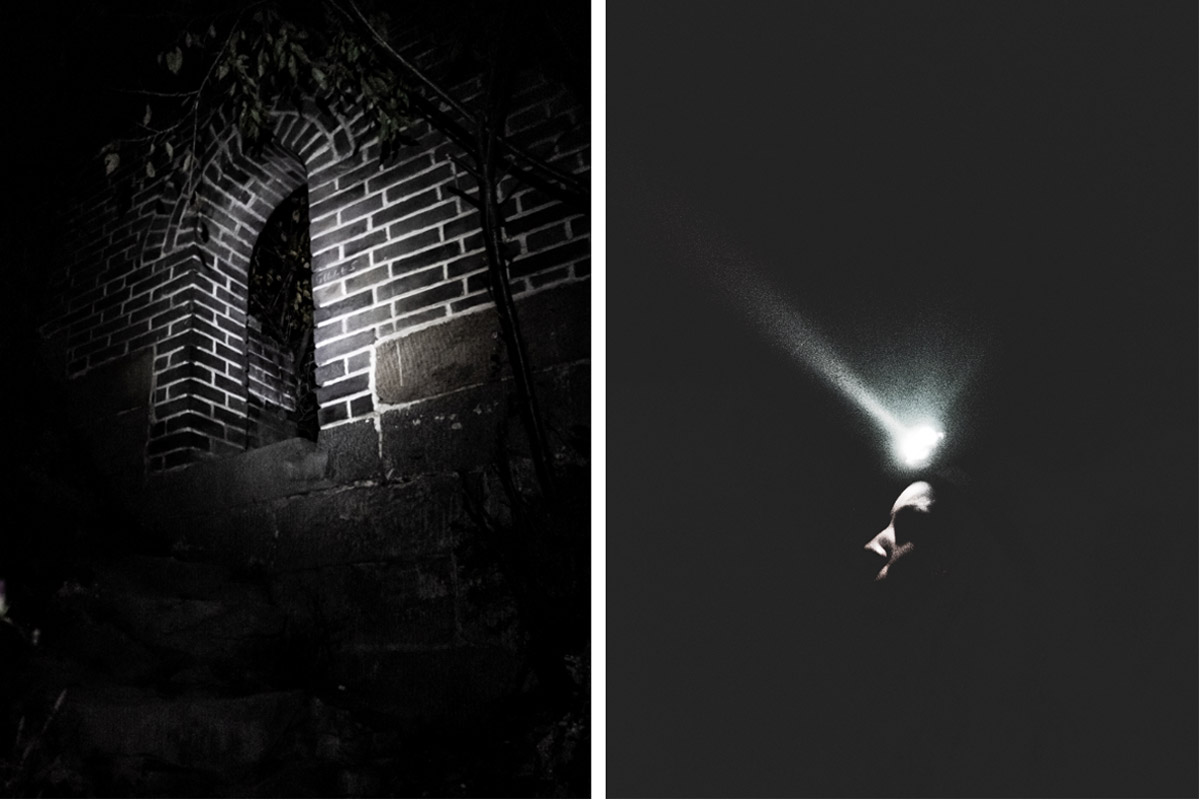
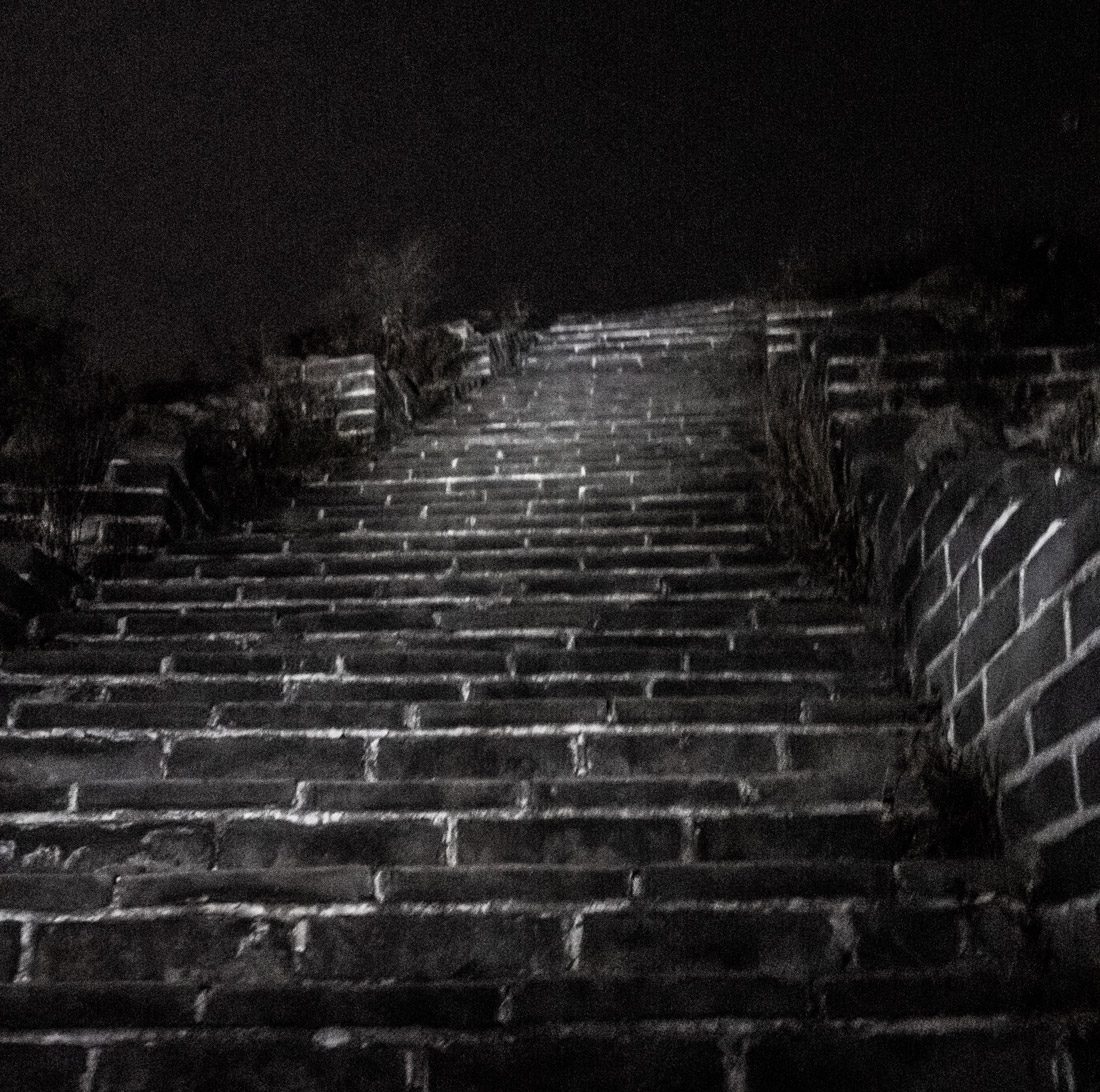
Here we are We turn off our fronts.
No more light, no more noise. As our eyes become dark, the wild parts of the Great Wall of China appear under the pale moonlight.
One cannot resist the desire to walk for a while on this mythical building revealed naturally by the pale halo. The lunar whiteness gives the moment a mystical dimension as she alone knows how to do. However, it is not too long, there is nothing to go through the wall at night: besides the dangerous side, it is also a shame to deprive oneself of the landscapes. We are looking for a place to install our tent without hindering the passage of potential visitors or risk damaging fragile parts. The 8 kms that separate us from our arrival point will be tomorrow.
Sleep on the Wall?
It is strictly prohibited on tourist sections whose access is regulated. On the other hand, it is tolerated on these wild parts. This practice was previously not common but more and more tourist agencies are starting to offer this experience. If you go on your own, be discreet and respect the rules of common sense as for the National Parks: installation of the camp late and up early, respect for the environment, no fire, leave no trace... and you can enjoy a new night in a fabulous place.

Day 2 – Discovery of the stunning non-restored parts
6:15 a.m. – Aurora awakening
Contrary to what had been announced at night was sweet and we slept incredibly well. After a great night experience, we have the head full of dreams and are looking forward to finally discovering the landscapes that surround us! We were not disappointed with the surprise:


As our eyes slowly travel the horizon, we realize the way travelled the night before. When we turn around, we savor the one waiting for us today: a little less than 10kms to reach the next small village known to house totally submerged parts of the Wall. You read it well: in this place... The stone snake literally plunges into a large lake.
7:30 - We're up.
We don't hang out, at the end of the day we'll have two new buses to take to explore another piece of stone ribbon known to be one of the most formidable. It is now that we say goodbye to the flat floors, the shortcuts and the paths that bypass the difficulties, the bridges and tunnels that free from the elevation: here the wall ruthlessly marries the ridges and cliffs of the steep mountains.
We can quickly see that It's the kind of grand building that doesn't visit... But conquer. Brut, wild, steep: the non-tourist parts are not to be pleasant but according to their original purpose, intimidate and protect. As if to respect their vocation from the time of war from the beginning they give the difficulty to face: We're going to have to get it all down... To get it all back. In the distance, we see a section that seems even more dilapidated: there the walls seem to have collapsed and the stones have been absorbed by vegetation. We will soon have a clean heart.


The first stairs fall to peak and go up arrow. They are exceptional views on everything we have to go through. Nevertheless, at that time, it is not the difficulty that comes to our eyes... But beauty. The ivory beige walls have been there for millennia but still divide nature with such pride. In this season (September), the surrounding area was adorned with beautiful shades mixing green, brown and golden. Climbing, descending, sometimes twisting: The stone ribbon runs without avoiding any difficulties imposed by the ridges of the mountains.
We walk through this building tirelessly, admiring every watchtower we have to cross. Sometimes some are split over their entire height and reveal parts of the wall that nature gradually invades.
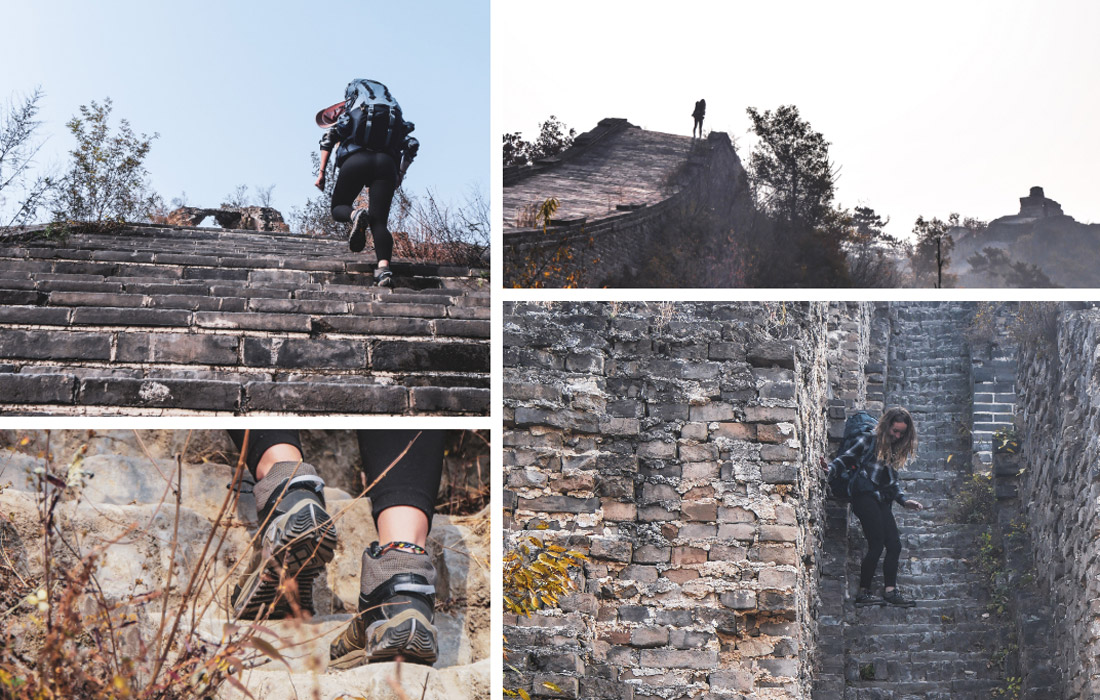

Over the kilometres we learn to concentrate on avoiding the traps that spice the adventure: stairways that run down, stones that roll under our feet, unstable piles that are supposed to help us climb, or even doors that lead straight to a vacuum.
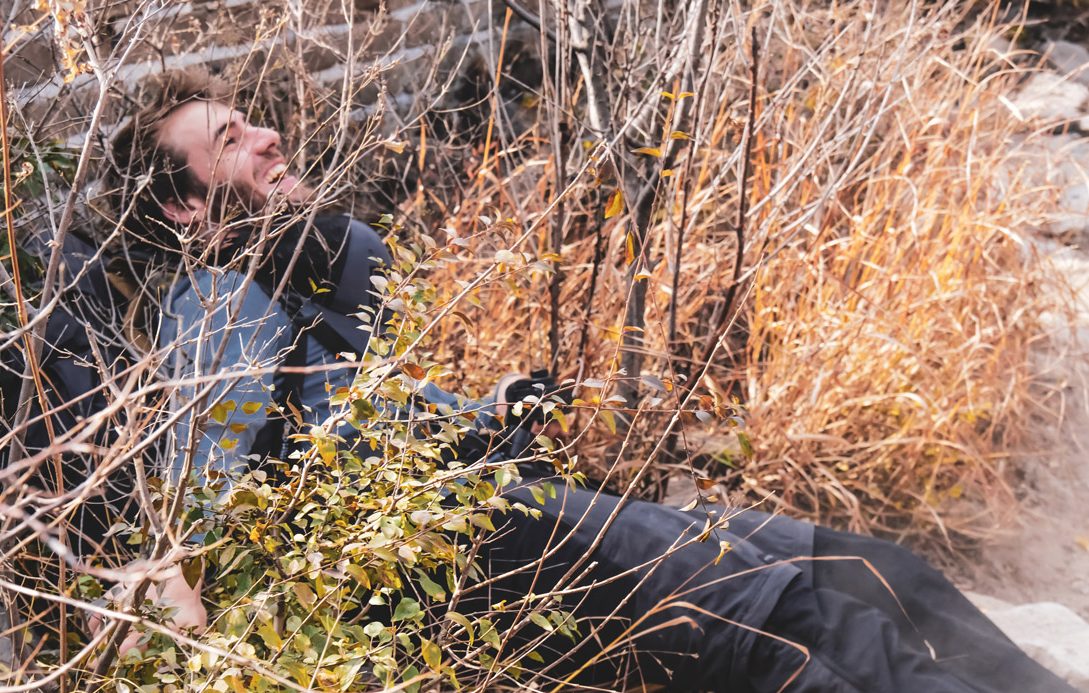
Our bags do not always pass in narrow places or through the doors in which we have to sneak. Other times, it is outright bushes or branches of trees that cling to and hold us. And finally, we teach our dependents that landscapes are grandiose... But that it should not prevent us from always looking where we set foot, see last photo: « Maxime, stay focused! ».
A rhythm settles down and we take pleasure in every new step, every turn crossed, every look back to contemplate the surveyed path.


11:00. We weren't ready.
As we climb our umpteenth tower (this one is particularly high and the landslides force us to climb the summit to cross it) We find ourselves frozen in front of the landscape we see at the top: an immense azure lake into which the Great Wall of China flows. We know that this stretch marks the end of our hike: by the small opening on the ground floor of the tower we observe the following section that emerges from the lake: a completely renovated tourist area.


Our section ends here: where the ancient walls plunge irreparably into the lake of a deep blue to emerge from the other flaming new side. If we had freely accessed this part, we will not be able to do the same for the following: access is controlled and paid (40 yuan, about 6 euros, to travel 4km). All we have to do is start our descent, between colorful forest and a peaceful lake. From our perspective, We feel like we're heading straight to the azure depths.
Sometimes the Great Wall of China is too seriously damaged and falls to peak, it would be suicidal to continue. In these situations, look for the red and gold ribbons: they allow you to find alternative paths and reach the cities and villages.

12:00 – Back to civilization.
The change of scenery is there and the ground seems to us... Incredibly flat! As we walk through the small alleys towards the only bus station, the 25° start to become heavy and our water reserves are at the lowest. But we find the Grail: a small grocery store where 500ml beer is sold for 6 yuan (or 0.80€). We let you imagine the happiness that grabs us at that time.

All we have to do is take the buses.* which will lead us to the gates of a new adventure. Over there stands a section that awakens fear in the eyes of the inhabitants when the name is pronounced and is known to be the most dangerous of the Great Wall of China.
* You will be able to meet often very insistent taxis that offer amazing prices and tell you that your next bus will only be there in 3 hours, or will not arrive (that's not true). The journeys cost only a few euros with the small IC card that you can easily get from the bus station in Beijing: we'll detail everything Here.

FOR CONCLUSION
It is the story of a late and anxious arrival on millennia walls that has turned into an incredible experience. If you love bivouacs and wild landscapes, go! We saw for the first time in our lives this legendary building under the moonlight: it was magical, we can't find any other words. If you want to discover the confidential and wild parts of the Great Wall of China, take up a small sporting challenge and take full eyes from the abandoned towers, don't hesitate anymore.
Thank you for traveling with us through this adventure story.
Living such an experience requires preparation: for your safety and in order not to have a negative impact on this exceptional heritage, it is up to everyone to preserve it. You will find all our practical tips in our article « Tips & best practices for exploring wild sections ».
We hope you enjoyed this moment and that it allowed you even a little bit to escape... Beyond the walls. We'll be glad to hear your comments and questions in comment, We always answer.

C’est impressionnant quand je lis votre article et je ne pensais pas que Pékin se trouvait à seulement 40 km, lol. C’est beau de se réveiller avec une si jolie vue sur la Grande Muraille de Chine, lol. En plus, le fait que tout soit si calme doit être apaisant.
C’était un peu un rêve / challenge pour nous de dormir sur ce monument légendaire, ce matin là c’était presque aussi fort qu’un 25 décembre haha
C’est magnifique de réaliser ses rêves, profitez à fond de tous ces moments 🙂
Vos photos sont incroyables ! Celle du réveil avec la tente et la muraille m’a donné envie d’y aller dès maintenant 🙂
Bravo pour votre article !
Merci beaucoup Sarah, ça été un souvenir tellement fort pour nous !
Hello ! Questions un peu logistiques… Vos tentes et duvets, vous les avez amenés depuis la France ? Et quel est ce village à partir duquel vous avez débuté cette première aventure ? Merci d’avance ????
Hello
Oui depuis la france pour l’équipement, pour le village il faut que je recherche 🙂
Salut, je m’apprete à partir sur cette route aussi 🙂
Si jamais vous auriez en tete le nom du tronçon que vous aviez parcouru, je suis preneuse !
J’imagine que c’est de Mutianyu/Jiangkou ou Simatai/jingshangling/Gubeiku ?
Merci d’avance !
Hello !
Alors nous c’était Jiangkou du coup, une section très très sauvage, depuis ces 6 dernières années nous n’avons pas eu d’update concernant l’état de la muraille, prudence 🙂